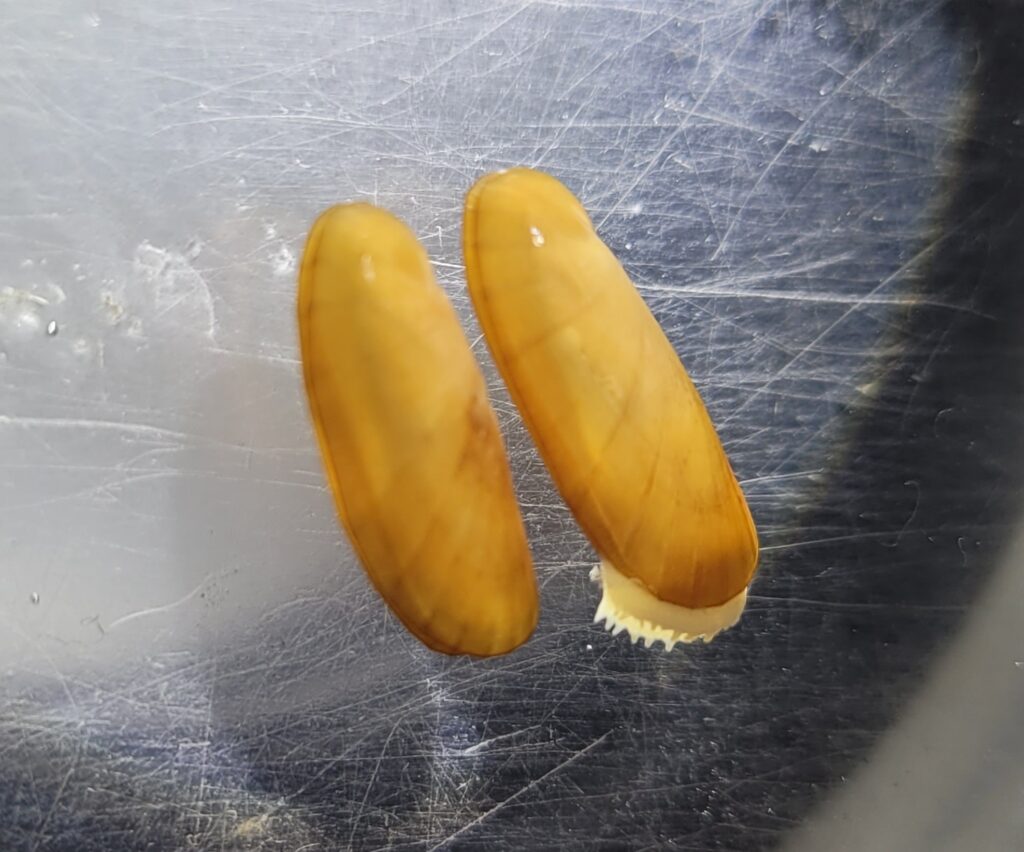
Our newest featured (shell)fish is the Atlantic awning clam, a pretty little bivalve with some pretty unique biology!
Atlantic awning clams (Solemya velum) are a marine mollusk that loves subtidal and intertidal sediments, with a preference for low oxygen and high organic matter. That makes them especially fond of salt ponds, salt marshes, and sewage outfalls. If you’re thinking that those tend to be somewhat smelly habitats, you’re right. But that has to do with what makes them unique.
Most bivalves are filter feeders: They draw water in through their siphons and use specialized gill structures to sift out food particles. But the Atlantic awning clam—and other clams in the family Solemyidae—are exceptions to the rule. Solemyids have small or even non-existent digestive tracts. Instead, their gills are specialized to house symbiotic, chemosynthetic bacteria. The bacteria need oxygen and sulfur (hydrogen sulfide) to thrive, and the clam provides both for them.
Atlantic awning clams live in Y-shaped burrows: One part of the burrow goes up, letting the clam draw in oxygenated seawater, and the other part goes down into the mucky, stinky sediments they inhabit. As you may have guessed, these sediments are full of hydrogen sulfide, the source of that rotten egg smell. The chemoautotrophic bacteria, provided with everything they need, feed themselves and their host through sulfur oxidation reactions. Those reactions involve breaking down sulfur compounds (which tend to be toxic to other organisms) and taking up CO2 (i.e., fixing carbon). Therefore, these reactions aren’t just providing sustenance, they’re also inadvertently cleansing the surrounding habitat—showcasing the important ecological role they play as well!
The Atlantic awning clam can grow to be about 8-10 cm long and ranges from Florida to Nova Scotia in intertidal areas. But other species in Solemyidae can inhabit deeper habitats, including hydrothermal vents and cold-seeps—some Solemyids are found 6,000 meters deep! Solemya velum is so good at what it does, it’s become a model organism for studying bacterial symbiosis in bivalves (and animal/bacteria symbiosis in general) and for studying marine carbon cycling. It just goes to show that sometimes amazing things are happening in tiny (shelled) packages!